


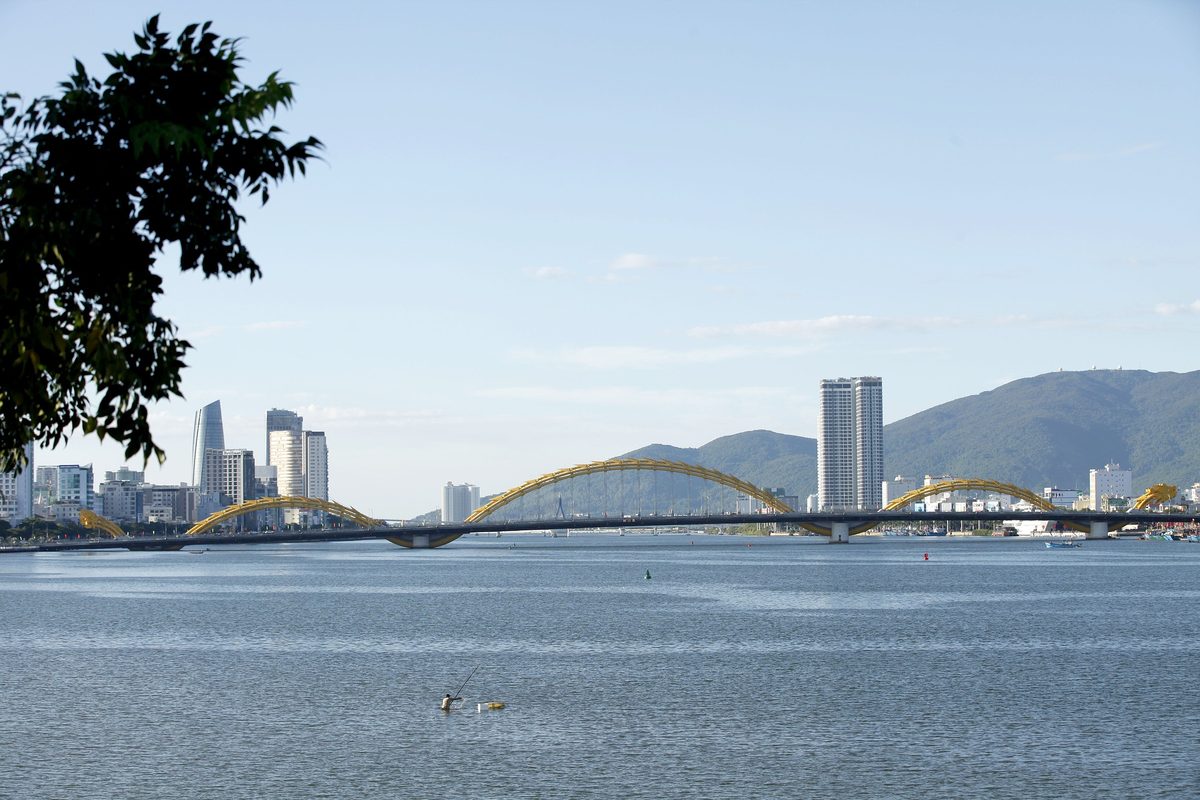
The Da Nang airport to city centre transfer is the shortest airport run in Vietnam. The distance is around five kilometres and the drive takes roughly 15 minutes, which is unusual enough that first-time arrivals often assume they have misread the map. This guide covers rates by vehicle, how the short distance changes the taxi comparison, and which riverside area you actually want to be dropped at.
How far is Da Nang city centre from the airport?
About five kilometres, or 15 minutes in normal traffic. Da Nang International sits inside the city rather than outside it, so there is no highway stretch and no long access road. You leave the terminal, cross a few boulevards, and you are at the Han river.
Traffic is light by Vietnamese standards. Even in the evening peak the journey rarely stretches beyond 25 minutes, and there is no equivalent of the long congested approach that arrivals into Ho Chi Minh City or Hanoi have to absorb.
Da Nang city centre transfer prices
Rates below read live from the MUINE EXPRESS rate source, so they match exactly what is applied when you book.
| Vehicle | Passengers | Price (VND) | Price (USD) |
|---|---|---|---|
| MICRO Sedan | Up to 2 passengers | 520.000₫ | $20 |
| ECONOMY MPV | Up to 3 passengers | 650.000₫ | $25 |
| MINIVAN Minivan | Up to 4 passengers | 780.000₫ | $30 |
| MINIBUS 16S Ford Transit | Up to 7 passengers | 1.040.000₫ | $40 |
| MINIBUS 16S+ Hyundai Solati | Up to 9 passengers | 1.170.000₫ | $45 |
| MINIBUS 18S Ford Premium+ | Up to 11 passengers | 1.300.000₫ | $50 |
| MIDI COACH 29S Hyundai/Thaco | Up to 20 passengers | 2.600.000₫ | $100 |
| COACH 45S Hyundai/Thaco | Up to 40 passengers | 4.940.000₫ | $190 |
Prices are per vehicle, not per passenger. VND shown at 26.000 per 1 USD.
The route starts at $20 and reaches $190 for the largest vehicle. There are 9 classes covering 2 to 40 passengers, and in local currency the entry rate is 520.000₫.
The price covers the vehicle rather than the seat, so four people travelling together pay the same as one person in the same car. On a five kilometre run that makes the per-person cost genuinely small for a group.
Transfer, taxi, or ride-hailing
This is the one route where the honest answer is that a metered taxi is cheap, because the distance is so short that the meter barely climbs. If you are a solo traveller with hand luggage and you are comfortable negotiating at the rank, a taxi will cost less than a booked car.
Ride-hailing apps work well in Da Nang and coverage at the airport is reliable, which is not true everywhere in the country.
So why book ahead at all? Three situations make it worthwhile. Late-night arrivals, when the rank thins out and the remaining drivers know it. Families with children and multiple suitcases, where a pre-assigned vehicle removes the luggage argument entirely. And travellers who simply want a name board waiting rather than a queue after a long flight.
Being straight about this matters more than upselling. On a 200 kilometre route the case for a private car is obvious. On five kilometres it depends on your circumstances, and pretending otherwise would be dishonest.
Which part of the centre do you want?
Da Nang’s centre is not a single point, and the answer shapes your drop-off. The Han river’s west bank around Bach Dang street is the administrative and dining heart, closest to the Dragon Bridge and the night market.
The east bank across the river runs toward My Khe beach and is where most of the newer hotels sit. It is still called the centre in casual speech but adds a few minutes and a bridge crossing.
If your hotel address contains An Thuong or My An, you are in the beach district rather than the riverside centre. Tell the driver the hotel name rather than the district, since the two areas are frequently confused by visitors.
Pickup at Da Nang airport
The airport has a domestic and an international terminal side by side, a short walk apart. Your driver waits in the arrivals hall holding a name board.
Because the terminal is compact, the walk from the exit to the vehicle is genuinely brief. There is none of the long car park trek that larger airports impose after a flight.
Choosing a vehicle
A four-seat car handles couples and solo travellers with normal luggage comfortably. Three or four people with full suitcases will want a seven-seat vehicle, mostly for the boot space rather than the legroom on such a short trip.
Groups above seven should take a sixteen-seat van. On a five kilometre journey the larger classes cost more per kilometre than they would on a long route, so it is worth checking whether two smaller cars suit your group better.
Arriving in the city
Most riverside hotels are on or just off Bach Dang and Tran Phu, and drivers know these streets well. The Dragon Bridge is the landmark everyone recognises, and it breathes fire on weekend evenings, which is worth timing your first night around if you can.
The Han Market sits a few minutes’ walk from the riverside hotels, and the beach is a short ride across either bridge. Very little in central Da Nang requires a long journey once you have arrived.
Late-night and early-morning arrivals
Da Nang receives a number of flights that land after midnight, and this is where a pre-booked transfer earns its keep. The taxi rank is thinner, the negotiation is less friendly, and a driver holding your name is simply less friction at two in the morning.
Early departures work the same way in reverse. A car booked for a 4am pickup removes the risk of standing outside a hotel hoping an app finds you.
Frequently asked questions
How long does a Da Nang airport to city centre transfer take?
Around 15 minutes for the five kilometre journey. Allow 25 minutes during the evening peak, though serious delays are rare on this route.
Is a taxi cheaper than a booked transfer?
Usually yes, because the distance is short and the meter stays low. A booked car makes more sense for late-night arrivals, families with luggage, or anyone who prefers a driver waiting with a name board.
Can the driver take me to My Khe beach instead?
Yes, though that is a slightly different destination across the river and priced separately. Give the hotel name when booking so the correct route is applied.
Is there a night surcharge?
Rates shown are the standard rates for the route. Confirm at booking if your flight lands in the small hours so the driver is scheduled correctly.
How much luggage fits in a four-seat car?
Two large suitcases plus cabin bags is comfortable. Beyond that, the seven-seat vehicle is the better choice even on a short journey.
Is a return transfer available?
Yes. Return bookings are available and priced at a discount against two separate one-way journeys.
Onward travel from Da Nang
Most visitors treat the city as a base rather than a final stop. Hoi An is the common next move, and the Da Nang airport to Hoi An transfer covers around 30 kilometres along the coast.
The mountain complex west of the city is the other popular day trip, reached by the Da Nang airport to Ba Na Hills transfer. Travellers heading north for the imperial city take the Da Nang to Hue route over or under the Hai Van pass.
What travellers get wrong about Da Nang
The most common mistake is booking a beach hotel while planning a riverside holiday, or the reverse. The two areas are only a few minutes apart by car but feel entirely different on foot, and walking between them across a bridge is longer than the map suggests.
The second is underestimating the city itself. Many arrivals treat Da Nang purely as the gateway to Hoi An and give it a single night, then wish they had stayed longer once they see the riverfront and the beach.
Related routes
More route guides, timings and rates are collected in the MUINE EXPRESS travel guide.