


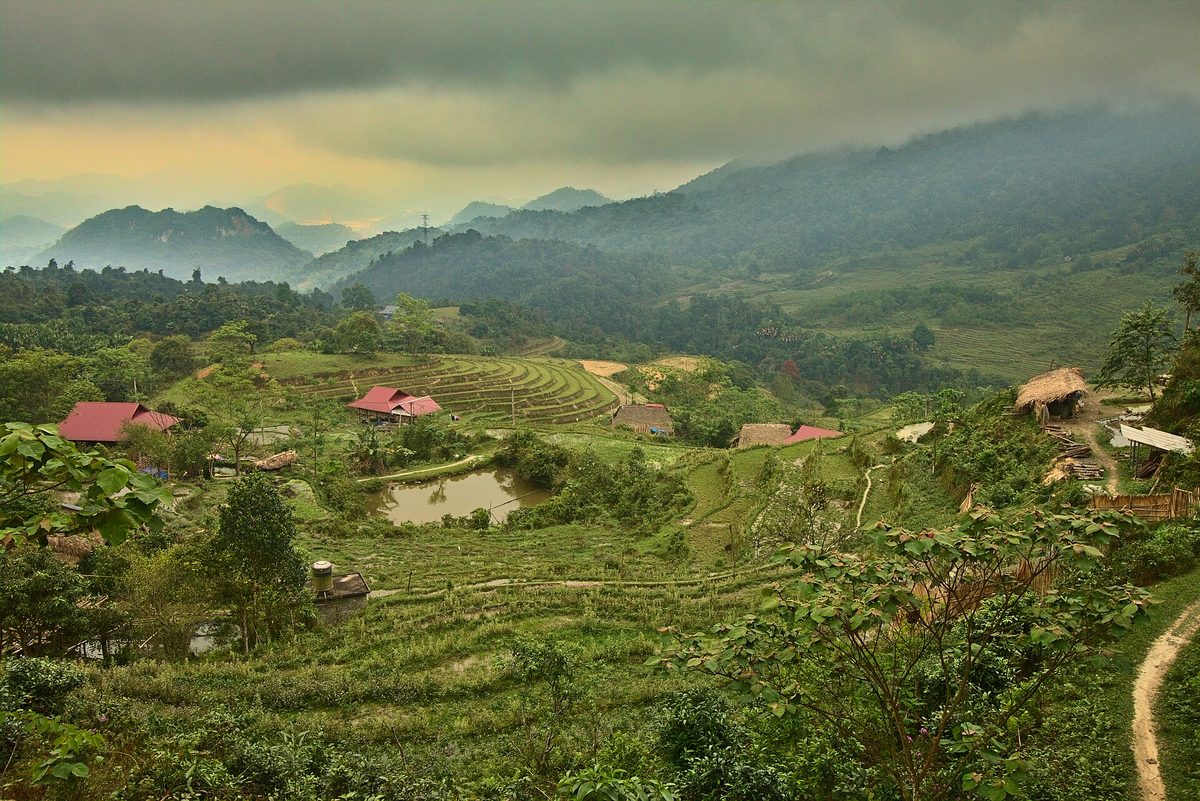
The Hanoi airport to Ha Giang transfer is the longest road journey MUINE EXPRESS operates from the capital, covering roughly 300 kilometres north to the edge of the Dong Van karst plateau. Allow six to seven hours rather than the five that raw distance suggests, because the second half of the route is mountain road.
How far is Ha Giang from Hanoi airport?
About 300 kilometres. The first section runs on expressway and moves quickly, then the road becomes provincial highway through Tuyen Quang province, and the final approach climbs and winds.
Estimating this journey purely from distance is the most common planning error travellers make. On paper it looks like five hours. In practice the passes, the truck traffic on the single-carriageway sections and the rest stops put it closer to seven, and pretending otherwise would leave you arriving in the dark unprepared.
Ha Giang transfer prices
Rates read live from the MUINE EXPRESS rate source, so the figures below are the ones applied at booking.
| Vehicle | Passengers | Price (VND) | Price (USD) |
|---|---|---|---|
| MICRO Sedan | Up to 2 passengers | 3.120.000₫ | $120 |
| ECONOMY MPV | Up to 3 passengers | 3.250.000₫ | $125 |
| MINIVAN Minivan | Up to 4 passengers | 3.380.000₫ | $130 |
| MINIBUS 16S Ford Transit | Up to 7 passengers | 3.640.000₫ | $140 |
| MINIBUS 16S+ Hyundai Solati | Up to 9 passengers | 3.770.000₫ | $145 |
| MINIBUS 18S Ford Premium+ | Up to 11 passengers | 3.900.000₫ | $150 |
| MIDI COACH 29S Hyundai/Thaco | Up to 20 passengers | 5.200.000₫ | $200 |
| COACH 45S Hyundai/Thaco | Up to 40 passengers | 7.540.000₫ | $290 |
Prices are per vehicle, not per passenger. VND shown at 26.000 per 1 USD.
The route starts at $120 and reaches $290 for the largest vehicle. There are 9 classes covering 2 to 40 passengers, with the entry rate at 3.120.000₫ in local currency.
Pricing is per vehicle, so on a journey this long a group of four sharing one car pays a fraction per person of what a solo traveller does.
Why people go to Ha Giang
Ha Giang city itself is a staging post rather than a destination. Travellers come for the loop north of it through Quan Ba, Yen Minh, Dong Van and Meo Vac, which is widely considered the most dramatic mountain road in Vietnam.
The landscape is limestone karst on a scale that photographs struggle with, cut by the Nho Que river gorge and terraced by generations of farming. The ethnic minority communities along the route maintain markets and traditions that are genuinely rather than performatively local.
Most visitors ride the loop by motorbike over three or four days, either self-driving or with an easy rider. Others hire a car and driver. Either way, Ha Giang city is where the trip begins.
Why a private car makes sense here
The alternatives are a sleeper bus or a limousine van, both of which run overnight and both of which arrive in the small hours. Buses are considerably cheaper and many travellers use them without complaint.
What a private car buys is control. You leave when your flight lands rather than when the bus departs, you stop when you need to on a seven-hour drive, and you arrive at your guesthouse rather than at a roadside drop-off point.
For travellers landing at Noi Bai in the afternoon with a loop tour starting the next morning, this is often the difference between arriving rested and arriving at three in the morning having slept badly on a bus.
Pickup at Noi Bai airport
Your driver waits in the arrivals hall with a name board. Terminal 2 handles international flights and Terminal 1 domestic, and they are a short shuttle apart, so give your flight number at booking.
Confirm the guesthouse address in Ha Giang city rather than just the city name. Accommodation there is spread across the town and along the river, and the exact address saves circling at the end of a long day.
Choosing a vehicle
On a seven-hour drive the vehicle choice matters more than on any other route. A four-seat car is adequate for two people, but three or four passengers with luggage will find the seven-seat option meaningfully more comfortable.
Groups above seven take the sixteen-seat van. The mountain sections are handled routinely by vehicles this size, and the extra space is welcome on the winding final hours.
Breaking the journey
Most drivers stop once or twice, typically in Tuyen Quang for food and again before the climb. Tell your driver early if you want a longer break or a specific stop.
Some travellers split the trip with a night in Tuyen Quang or Ha Giang’s outskirts, particularly if their flight lands late. It costs a day but turns a punishing drive into two comfortable ones.
Frequently asked questions
How long does a Hanoi airport to Ha Giang transfer take?
Six to seven hours in practice for the 300 kilometre journey. The mountain sections in the second half are what stretch it well beyond what the distance implies.
Is the road safe?
The route is used daily by buses and freight and is in reasonable condition. The mountain sections require an experienced driver, which is a good reason not to self-drive it after a long flight.
Should I take the bus instead?
The sleeper bus is far cheaper and many travellers use it. A private car makes sense if you want daytime departure, control over stops, or door-to-door delivery to your guesthouse.
Can the driver continue onto the loop?
The loop is a separate multi-day arrangement rather than part of this transfer. Ask when booking if you want a car and driver for the mountain circuit as well.
When is the best time to go?
September and October for the rice terraces, and the drier months from October to April for road conditions. Heavy summer rain can cause landslides on the mountain sections.
Is a return transfer available?
Yes. Booking the return is sensible given how few options run back from Ha Giang during daylight hours.
What the drive actually looks like
The first two hours leaving Noi Bai are unremarkable expressway through flat delta country, and most passengers sleep through them. The scenery changes around Tuyen Quang, where the road narrows and the hills start.
The last stretch is the one people remember. The road climbs through forested slopes with the karst peaks appearing ahead, and by the time you reach Ha Giang city the landscape has changed completely from what you left at the airport.
Sitting on the right side gives the better views for most of the climb. Passengers prone to motion sickness should say so early, because the winding sections come in long unbroken stretches rather than isolated bends.
Arriving and what happens next
Ha Giang city is small and most guesthouses are within a few minutes of each other. Loop tours, motorbike rentals and easy riders all operate from the town, and briefings usually happen the evening before departure.
Permits for the border areas are arranged locally and your accommodation or tour operator handles them. They are routine, but they take time, which is another argument for arriving in daylight rather than after midnight.
Cash matters more from here north. ATMs exist in Ha Giang city but become scarce on the loop, and homestays and roadside food are cash-only almost without exception.
Other routes from Hanoi
Travellers heading east to the bay take the Hanoi airport to Ha Long transfer, those going into the capital itself use the Hanoi airport to city centre transfer, and the northern hill station is served by the Hanoi airport to Sapa transfer.
Planning realistically
Book the transfer for a flight that lands before early afternoon if you can. Leaving Noi Bai at two in the afternoon means arriving around nine in the evening, which is manageable. Leaving at six means the mountain section is entirely in darkness.
Build a buffer day into the itinerary as well. Weather closes sections of the northern roads occasionally, and a schedule with no slack turns a delay into a cancelled loop.
Related routes
Rates, timings and route guides for northern Vietnam and the rest of the country are collected in the MUINE EXPRESS travel guide.