


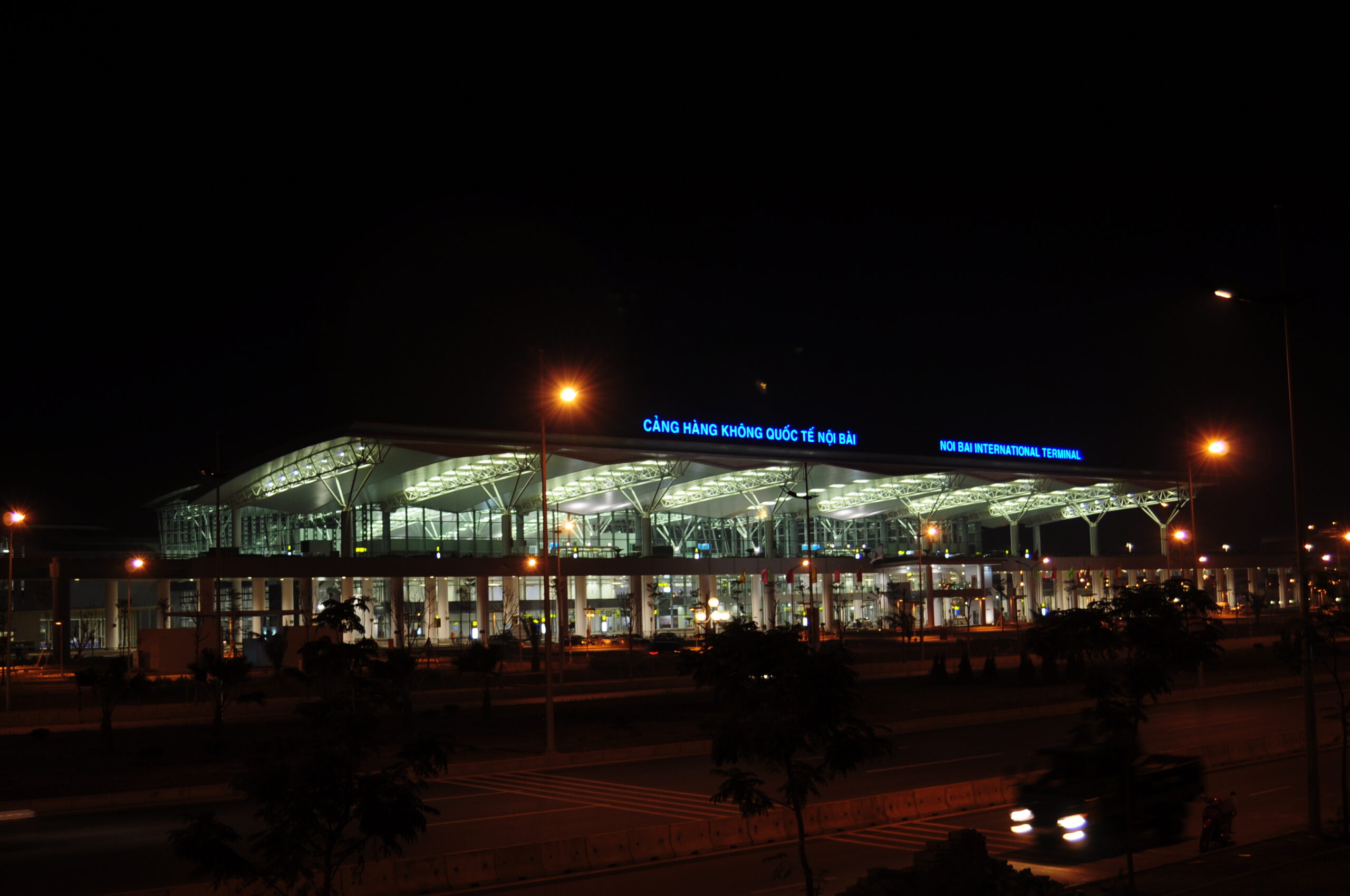
The Hanoi airport to city centre transfer is the first road journey most visitors make in Vietnam, and it is short enough that the details actually matter. Roughly 27 to 35 kilometres separate Noi Bai International Airport from the central districts, depending on exactly where you are staying. This guide covers the route, honest timing by time of day, what to expect if your hotel is in the Old Quarter, and current vehicle rates.
The route and why the bridge matters
Noi Bai sits north of the Red River, and central Hanoi sits south of it. Every transfer therefore involves a river crossing, and which bridge the driver uses shapes the journey.
Most transfers now take Vo Nguyen Giap boulevard south from the airport and cross via Nhat Tan Bridge. That bridge and its approach road opened in 2015 specifically to serve the airport, and it cut a substantial amount of time from what used to be a slower crossing through older infrastructure. It is a cable-stayed bridge with distinctive towers, and it is genuinely a pleasant first view of the city, particularly when the towers are lit after dark.
From the southern bank the road continues toward the centre. Where you end up depends on your district. Hoan Kiem, which contains the Old Quarter and the lake most visitors picture when they think of Hanoi, is the most common destination. Ba Dinh, Tay Ho around the west lake, and the newer Cau Giay district are also frequent drop-offs.
How long it takes, honestly
Outside peak periods, 30 to 45 minutes is realistic. That is the figure to plan around for a mid-morning or early-afternoon arrival.
Peak traffic changes the picture. Hanoi rush hours run roughly from seven to nine in the morning and from half past four to seven in the evening, and during those windows the same journey can stretch past an hour. The bridge itself flows reasonably well; the congestion builds in the central districts where the road network is older and denser.
Late-evening arrivals are the fastest. After nine at night the run into the centre frequently takes under half an hour. Many long-haul flights land in that window, which works in your favour.
Hanoi airport to city centre transfer: vehicles and current rates
The table reads live from our transfer-rate source, so what you see is the current published rate for each vehicle class on this route.
| Vehicle | Passengers | Price (VND) | Price (USD) |
|---|---|---|---|
| MICRO Sedan | Up to 2 passengers | 650.000₫ | $25 |
| ECONOMY MPV | Up to 3 passengers | 780.000₫ | $30 |
| MINIVAN Minivan | Up to 4 passengers | 910.000₫ | $35 |
| MINIBUS 16S Ford Transit | Up to 7 passengers | 1.170.000₫ | $45 |
| MINIBUS 16S+ Hyundai Solati | Up to 9 passengers | 1.300.000₫ | $50 |
| MINIBUS 18S Ford Premium+ | Up to 11 passengers | 1.430.000₫ | $55 |
| MIDI COACH 29S Hyundai/Thaco | Up to 20 passengers | 2.600.000₫ | $100 |
| COACH 45S Hyundai/Thaco | Up to 40 passengers | 4.940.000₫ | $190 |
Prices are per vehicle, not per passenger. VND shown at 26.000 per 1 USD.
This is a short journey, so vehicle choice comes down to luggage rather than comfort over distance. A couple with two suitcases is well served by the smallest class. A family of four with four large cases is not, regardless of what the seat count says — luggage volume, not passenger count, is what fills a vehicle on airport runs.
Larger groups arriving together on the same flight often find that one larger vehicle costs less than multiple small ones, and it keeps everyone together on arrival. The table shows the full range so you can compare directly.
The Old Quarter problem
This deserves its own section because it surprises people every day.
The Old Quarter is a dense grid of narrow streets, many of them one-way, some barely wide enough for a car. Plenty of hotels there cannot be reached by a standard vehicle, let alone a minibus. Your driver may need to stop at the nearest street a vehicle can enter, which could be a short walk from your door.
This is not a shortcoming of the transfer; it is the physical reality of a neighbourhood laid out centuries before cars existed. What helps is knowing in advance. When you book, give your hotel name and street address rather than just the district, and we can flag whether the door is reachable.
Weekend evenings add another layer. Several Old Quarter streets around Hoan Kiem Lake close to vehicles entirely for the weekend walking zone, typically from Friday evening through Sunday night. If you arrive during that window, drop-off will be outside the pedestrian area.
What about the airport bus and ride-hailing apps?
Public bus routes connect Noi Bai to the city and cost a fraction of a private transfer. They run to a timetable, stop frequently, and terminate at fixed points rather than your hotel. With luggage and after a long flight, most visitors find the saving does not survive contact with reality — but if you are travelling light and unhurried, they work.
Ride-hailing apps operate in Hanoi and are widely used. The practical difficulties on arrival are the ones you would expect: you need a working data connection before you can book, the designated pickup area is not always obvious on a first visit, and there is no one waiting if your flight is delayed. A pre-booked transfer removes those variables by having a driver meet you with your name at arrivals.
Arrival practicalities
Noi Bai has two terminals. Terminal 1 handles domestic flights, Terminal 2 handles international. They are separate buildings connected by a shuttle, so telling us your flight number lets the driver wait at the correct one.
Immigration queues at Terminal 2 vary considerably. When several wide-body flights land together the wait can be substantial. Drivers monitor actual landing times rather than scheduled ones, so a slow queue does not mean a missed pickup.
Currency exchange and ATMs are available in the arrivals hall. Getting a small amount of Vietnamese dong before you leave the airport is sensible for incidentals, even though your transfer is settled separately.
Frequently asked questions
How do I get from Hanoi airport to the city centre?
By road across the Red River, most commonly via Nhat Tan Bridge and Vo Nguyen Giap boulevard. A private transfer meets you inside arrivals and drives directly to your accommodation.
How long does it take to get from Hanoi airport to the Old Quarter?
Typically 30 to 45 minutes outside peak traffic. During morning or evening rush hour, allow an hour or more. Late-evening arrivals are usually quickest.
How far is central Hanoi from the airport?
Between 27 and 35 kilometres depending on your district. Hoan Kiem and the Old Quarter sit at the longer end of that range.
Can a vehicle reach my Old Quarter hotel?
Sometimes. Many Old Quarter streets are too narrow or are one-way, and some close for the weekend pedestrian zone. Give us your exact hotel address when booking and we will confirm the nearest reachable drop-off point.
Which terminal will my driver meet me at?
Terminal 2 for international arrivals and Terminal 1 for domestic. Provide your flight number and the driver will be at the correct terminal, tracking your actual landing time.
Is a private transfer worth it for such a short trip?
It depends on your priorities. It costs more than the bus and removes the uncertainty of arranging transport after a long flight, particularly with luggage, at night, or with children.
Continuing your journey from Hanoi
Many visitors treat Hanoi as a base for the north. If Ha Long Bay is on your itinerary, our Hanoi airport to Ha Long Bay transfer guide covers the coastal route directly from the terminal, which saves a night in the city if your schedule is tight.
For the mountains, the Hanoi airport to Sapa transfer guide sets out the expressway route northwest and realistic timing for that considerably longer drive.
Send us your flight number and hotel address to confirm your transfer and meeting point.